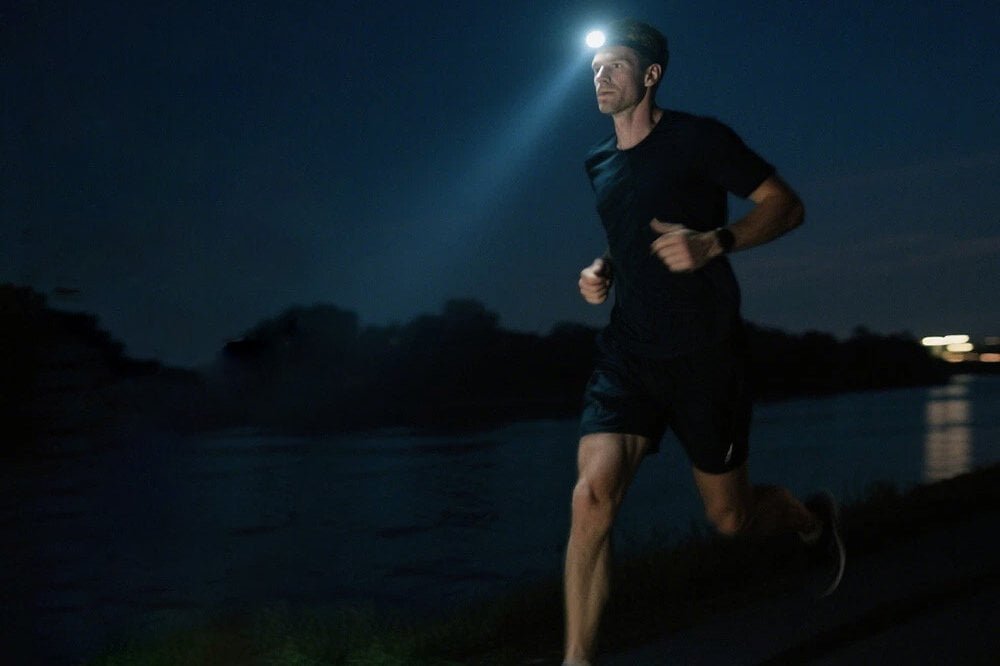
Night running gives you a sense of freedom that daytime running simply cannot match. However, the darkness brings risks, and the only thing standing between you and a twisted ankle is your light source.
To choose the best headlamp, you must first define your running environment1. For city runners, a lightweight, integrated headlamp2 with 150-300 lumens3 is ideal for seeing the pavement. For trail runners, a rear-battery design4 with 400+ lumens offers better balance, longer battery life5, and the reliability needed for rugged terrain.
Many people think a headlamp is just a flashlight with a strap. This is a mistake. If you buy the wrong one, it will bounce on your forehead, give you a headache, or run out of power halfway through your run. I have seen many buyers make these mistakes. Let's look at the specific features that actually matter for runners.
How Many Lumens Should a Headlamp for Running Have?
Marketing often tells us that "more is better," but this is not true for running lights. You do not need a searchlight on your head to run a 5K.
For most runners, a range of 100 to 450 lumens is perfect. City runners only need about 150-300 lumens to see the ground clearly. Trail runners need 400+ lumens to spot roots and rocks. Anything over 1000 lumens is usually unnecessary and just drains the battery.
In my experience working with lighting products for over a decade, I often see brands pushing 1000 or even 2000 lumens as a selling point. For a runner, this is often a trap. High lumens generate high heat. This causes the light to dim quickly to protect the electronics. Plus, super bright light can reflect off fog or wet pavement, causing glare that actually hurts your vision.
It is much more important to have a clean, even beam of light. You want a light that does not have a "hot spot" in the center that blinds you. You need a smooth transition from the center to the edges.
Here is a simple breakdown of what you actually need:
| Running Scenario | Recommended Lumens | Key Requirement |
|---|---|---|
| City / Urban | 150 – 300 Lumens | Soft light to see the path; allow cars to see you. |
| Trail / Forest | 400 – 600 Lumens | Stronger beam to see distance and obstacles clearly. |
| Technical / Ultra | 600+ Lumens | High reliability; usually requires a larger battery pack. |
Do not get distracted by the highest number on the box. Look for a light that stays consistent.
Which Headlamp Design is Better: Front-Integrated or Rear-Battery?
The structure of the headlamp determines how it feels on your head while you move. This is the biggest difference between a casual light and a pro running light.
There is no single "best" design, but there is a best design for your run. An integrated front design is lightweight and simple, perfect for short city runs. A rear-battery design4 splits the weight, offering better balance and battery life for long-distance or trail running.
This is a topic I discuss with clients all the time. We manufacture both types, and they serve different groups of runners. You need to understand the trade-offs.
1. The Rear-Battery Design (Battery on the back of the head) This is the professional choice for trail runners and marathoners. The lamp is in the front, but the heavy battery is on the back of the strap.
- Balance: The weight is split. The front doesn't pull down on your forehead. It stays stable even when you jump over rocks.
- Power: The rear case is bigger. We can fit larger batteries (like 18650s) inside. This means the light stays bright for much longer.
- Safety: Most of these designs have a red taillight on the battery pack. This is huge for safety if you run on roads.
- The Downside: It is heavier overall. You have a wire running along the strap. It takes up more space in your pocket.
2. The Integrated Design (All-in-one front unit) This is the popular choice for casual runners and city joggers.
- Convenience: It is small. You can throw it in a gym bag. There are no wires.
- Comfort: It is very light. For a quick 30-minute run, you barely feel it.
- The Downside: All the weight is on your forehead. If you run fast, it might bounce up and down. The battery is smaller, so it will not last as long on high power. Also, heat can build up on your forehead because the battery and light are together.
If you run for more than an hour, choose the rear-battery style. If you run for 30 minutes around the block, the integrated style is perfect.
Is Weight or Balance More Important for Comfort?
You might think the lightest headlamp is always the most comfortable. However, once you start moving, physics changes everything.
While a total weight of under 100 grams is a good target, balance is actually more important than raw weight. A slightly heavier lamp that is well-balanced will feel lighter than a featherweight lamp that bounces on your forehead with every step.

When you run, your body creates a constant vertical impact. If your headlamp is front-heavy, gravity pulls it down every time your foot hits the ground. To stop this, you have to tighten the strap.
If you tighten the strap too much, you get a headache. It is a vicious cycle.
This is why the rear-battery design I mentioned earlier is so popular for serious runners. It acts as a counterweight. But if you prefer the smaller, integrated lights, you must pay attention to the total weight.
For integrated lights, keep it under 100 grams. Once you go over that, the "bounce" becomes very noticeable. I have tested hundreds of prototypes. The moment an integrated front light gets too heavy, it becomes annoying to run with, no matter how bright it is.
Also, look at the shape of the bracket that touches your forehead. A curved, ergonomic bracket6 spreads the pressure. A flat bracket will dig into your skin. Comfort is not just a luxury; it is necessary for focus. If you are thinking about your forehead pain, you are not thinking about the trail.
Which Power Source Offers the Best Runtime Reliability?
Running out of power in the woods is scary. Running out of power in the city is annoying. You need a power source that fits your habits.
The best modern solution for runners is "Dual Power." This means the headlamp runs on a rechargeable lithium battery but can also accept standard AAA batteries as a backup. This gives you the cost-savings of rechargeable tech with the safety net of disposable batteries.
In the past, you had to choose. Lithium batteries are light and hold a steady voltage. This means the light stays bright until the battery dies. AAA batteries are heavy and the light gets dimmer as they drain.
But here is the reality of running: You cannot stop to plug in a USB charger at mile 10.
If you are doing a long run or a race, you need a backup plan. This is why I always recommend Dual Power (sometimes called Hybrid Power) to our clients. You use the lithium pack for your daily training. It saves you money. But for a long race, you carry three spare AAA batteries in your pocket. If the light dies, you can swap them in 30 seconds.
Runtime vs. Battery Type: Do not just look at the battery type. Look at the runtime chart on the packaging.
- High Mode: Usually only lasts 2-4 hours.
- Medium Mode: This is where you will spend 90% of your time. Make sure this mode lasts longer than your longest planned run.
If a headlamp claims "100 hours of runtime," read the fine print. That is usually on the lowest "moonlight" setting, which is useless for running. Focus on the medium setting.
Do You Really Need Complex Lighting Modes and Sensors?
Technology is great, but sometimes engineers add too many features. When you are tired and sweating, you do not want to solve a puzzle to turn off your light.
You need a headlamp with a simple interface7 and a 45-degree adjustable tilt. While motion sensors are popular, avoid headlamps with too many flashing modes or complex button combinations. A simple "Low-Med-High" sequence is best for runners.
I have handled many complaints from end-users over the years. A very common complaint is: "I can't figure out how to turn it off."
Imagine this: You are running on a dark trail. You hear a car coming. You want to dim your light so you don't blind the driver. But instead of dimming, your headlamp starts flashing in "SOS" mode because you pressed the button twice instead of once. It is frustrating and dangerous.
The Golden Rules of Interface:
- Tilt is Mandatory: The light must tilt down at least 45 degrees. You need to look at the ground 3-5 meters in front of you, not the trees. If you have to tilt your neck down to see the path, your neck will hurt after 10 minutes.
- Memory Mode is Nice: Good headlamps remember the last setting you used. When you turn it on, it goes back to that brightness.
- Less is More: You need a focused beam for running and maybe a flood beam for resting. You do not need strobe, SOS, beacon, green light, and blue light all on one button.
- Motion Sensors: Many running lights now have "wave to turn on/off" sensors. These are cool in the store. But on the trail, tree branches or your own hand wiping sweat can trigger them accidentally. If you buy one with a sensor, make sure you can lock it or turn the sensor off.
What Waterproof Rating and Strap Features Are Essential?
You cannot control the weather, but you can control your gear. Your headlamp needs to survive sweat and rain, and the strap needs to fit everyone.
For running, an IPX4 rating is sufficient for sweat and rain. If you run primarily in extreme weather, look for IPX6. Additionally, the strap must be breathable, reflective, and long enough to fit over a winter beanie.
Let's be real about waterproofing. IPX4 means "splash proof." For 95% of runners, this is enough. It handles heavy sweat and normal rain perfectly fine. Unless you plan to go swimming with your headlamp or run in a hurricane, you do not need to pay extra for IPX7 or IPX8 (submersible) ratings.
However, the headband is often overlooked.
- Sweat Management: The strap acts like a sweatband. It needs to be breathable and washable. If it absorbs too much water, it gets heavy and saggy.
- Reflectivity: Since you are running at night, the strap should have reflective threads woven into it. This gives you 360-degree visibility to cars.
The "Winter Hat" Problem: This is a specific insight from our customer feedback logs. We used to receive complaints in the winter. Customers would say, "The strap is too tight." We realized that in cold climates (like Northern Europe or Canada), runners wear thick wool hats. If the headlamp strap is standard length, it won't fit over the hat comfortably.
Now, we advise all our buyers to ensure the strap has a generous "maximum length" adjustment. If you run in winter, check this before you buy. If the strap is maxed out, it will squeeze your head and give you a headache.
Conclusion
Choosing a running headlamp is not about buying the one with the highest numbers. It is about stability and reliability. Whether you choose a lightweight city light or a balanced trail light, ensure it fits well and has a simple battery system. A good headlamp disappears on your head and lets you just run.
| Feature | Key Specifications | Expert Recommendations (SEO Focus) | Best For |
|---|---|---|---|
| Brightness | 150–450 Lumens | Focus on beam quality and uniform light rather than high lumens (1000+ is unnecessary). Avoid glare. | City (150-300lm) / Trail (400+lm) |
| Weight | ≤ 100 grams | Weight balance is more critical than total weight to prevent bouncing during repetitive motion. | Long-distance comfort |
| Design Type | Rear Battery vs. Integrated | Rear-battery offers better balance and runtime. Integrated is lightweight and portable for short runs. | Trail (Rear) / City (Integrated) |
| Battery Life | Dual Power Sources | Use headlamps compatible with AAA or Rechargeable Lithium batteries. Prioritize total runtime over battery type. | Endurance & Versatility |
| Operation | Simple UI & 45° Tilt | Avoid "mode fatigue." Choose fewer modes and reliable memory settings to maintain running flow. | High-intensity training |
| Durability | IPX4 to IPX6 Rating | IPX4 is sufficient for most rain. IPX6 is only necessary for extreme weather or technical trail racing. | All-weather running |
| Headband | Reflective & Adjustable | Ensure the band is breathable and long enough to fit over winter hats or beanies. | Safety & Winter running |
Understand how different environments influence the type of headlamp you should choose. ↩
Explore this link to find top-rated headlamps that enhance your night running experience. ↩
Learn about the ideal lumens for night running to ensure safety and visibility. ↩
Discover why a rear-battery design is favored by serious runners for comfort and balance. ↩
Check out insights on battery life expectations for running headlamps. ↩
Learn about the benefits of an ergonomic bracket for comfort during runs. ↩
Find out why a simple interface can enhance your running experience. ↩