In my daily work, I often help clients build their brands. Eventually, we touch upon a small but important group of users: kids. As a mother and an industry insider, I know that choosing the right light for a child is about much more than just picking a bright color.
The best flashlight for kids1 is one that prioritizes safety above all else. It should have a maximum output of 100 lumens2 to protect young eyes, a secured battery compartment3 to prevent ingestion, and be made of certified non-toxic materials4. It should offer simple modes like a low reading light5 and avoid any sharp, tactical designs.
Many people assume that because flashlights are common tools, finding one for a child is easy. However, the market is actually quite complex. I want to share my industry experience to help brand owners plan their product lines and help parents make safe choices.
Is the market for kids’ flashlights really that small?
When we look at the global market, we see that flashlights designed specifically for children are a very niche category. Most people do not realize how few dedicated options exist.
While a few specialized brands like KIDYWOLF6 and HABA7 focus on children's exploration gear, most major lighting brands do not have a dedicated line for kids. Brands like LedLenser8 and VARTA9 are exceptions, while others like Olight10 or Nitecore11 only offer models that are "suitable" rather than specialized.
In my years of analyzing the market for my clients, I have noticed a clear gap. You have brands like KIDYWOLF with their KIDYFLASHLIGHT and HABA with their Terra Kids line. These are famous because they focus entirely on toys and electronics for children. They understand the psychology of the child user. On the other side, we have the professional illumination giants. LedLenser and VARTA have stepped up with specific lines for kids, which is great to see. Fenix has a "headlamp for children," but it is not a full product line.
Then there is the rest of the market. Big names like Olight, Nitecore, Maglite, Acebeam, and Lumintop produce amazing high-power lights. In reviews, people often point out specific models from these brands that could be good for kids, but they were not built for kids from the ground up. This shows just how niche this market is. For a business owner, this represents an opportunity. For a parent, it means you have to look very carefully. You cannot just buy any small flashlight and assume it is safe for a 5-year-old. The scarcity of dedicated products means we have to be smarter about what we choose to put in our children's hands.
There are real risks involved when children use products designed for adults. This brings us to the most important factor in this entire discussion: age and safety awareness.
At what age should a child start using a flashlight?
There is a general consensus that these products are for ages 3 to 12, but I have a different opinion based on my experience.
I believe the minimum age for owning a personal flashlight should be at least 5 years old. At this age, a child begins to understand basic safety rules, which significantly reduces the risk of accidents like shining beams into eyes or dismantling the device.
Safety is the core concept here. We hear stories from all over the world about accidents involving children and flashlights. These are not just minor issues. They range from eye damage caused by high-intensity beams to severe internal injuries from swallowing batteries. There are also issues with skin reactions to improper materials or cuts from sharp designs. As a mother of two, I am extremely strict about what my children handle.
When I advise my clients on product development, I tell them to design for a 5-year-old mindset12, not a 3-year-old one. A 5-year-old can understand "right and wrong" regarding tool usage. They can follow the rule "do not shine this in your sister's face." Before this age, a flashlight is just a glowing object to be tasted or thrown. If you are a brand owner, you must consider these risks in your design. If you are a parent, you need to assess your child's maturity. A flashlight is a tool for exploration, not a simple toy. It empowers a child to see in the dark, but that power must come with safety boundaries. The goal is to encourage adventure without inviting danger.
Once we decide a child is old enough, the next technical question is about the light itself. We need to talk about lumens and beam types.
How bright should a flashlight for children be?
In the adult world, we are obsessed with high numbers, often looking for 1000 lumens or more. For children, this is dangerous and unnecessary.
A flashlight for kids should have a maximum output of 100 lumens2. Anything brighter is risky for young retinas. The best design includes three simple modes—High, Medium, and Low—with a specific low setting for reading that does not disturb others.
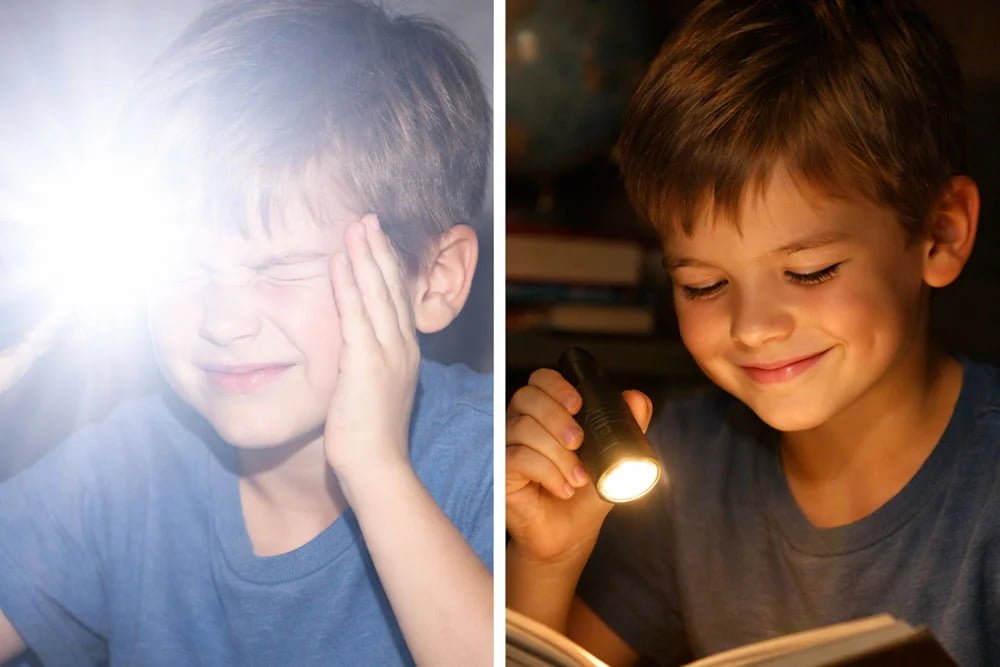
If you are running a brand, I suggest you cap your output at 100 lumens. There is absolutely no need for a child to have a searchlight. I personally believe a 3-mode design is perfect. If you have too many modes, the child gets confused. If you have only one mode, it is boring. The most important setting is actually the lowest one. I recommend a "Low" mode of about 5 lumens. Trust me on this. When a child gets a flashlight, the first thing they want to do is build a fort or read a comic book under the covers. A bright light in that small space hurts their eyes. A 5-lumen mode is perfect for reading and makes the battery last longer.
We also need to look at the beam shape. Do not use a focused "spot" light. A focused beam is too intense if it accidentally hits an eye. Instead, choose a soft "flood" light. It lights up a wider area and is much gentler. Another great tip for product managers is to add colored lights. Red light protects night vision, and blue light is fun for "tracking" games. These features add huge value for the child without adding cost or danger.
| Feature | Recommendation | Reason |
|---|---|---|
| Max Brightness | 100 Lumens | Protects sensitive eyes from glare. |
| Low Mode | 5 Lumens | Perfect for reading under blankets. |
| Beam Type | Soft Flood | Gentle coverage, no "hot spot" intensity. |
| Extra Colors | Red / Blue | Adds fun and utility for exploration. |
Light is important, but power is critical. The power source is the number one safety hazard in this industry.
Why is battery design the most critical safety feature?
This is the point I stress the most to every client I work with. It is a matter of life and death.
You must never expose the battery or make it easy to access. The battery compartment must be locked, preferably with a screw for button cells, to prevent children from swallowing batteries, which causes severe chemical burns.
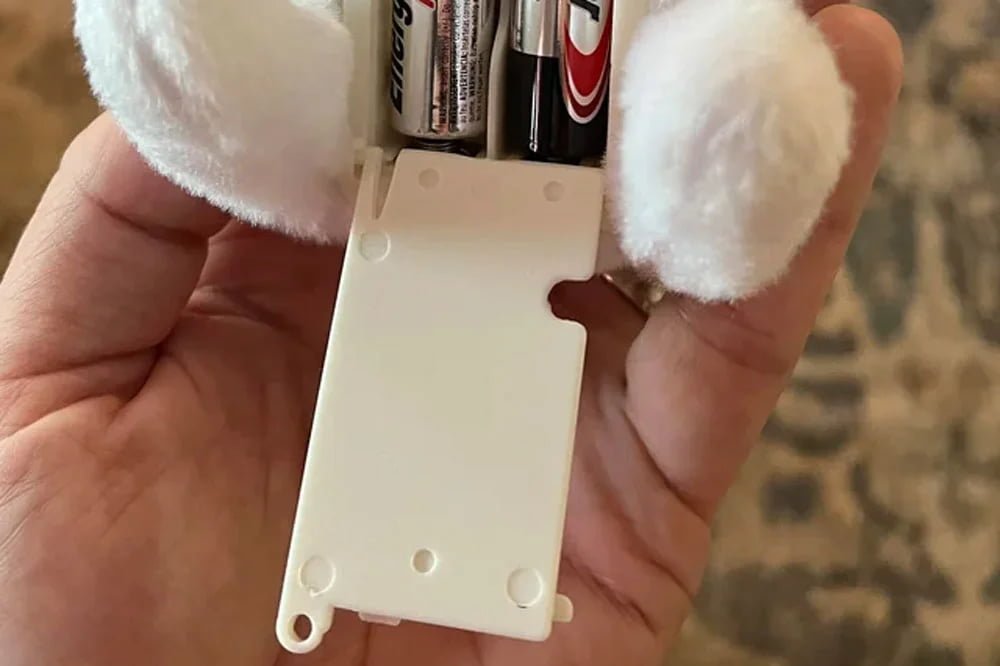
I cannot repeat this enough. In the lighting business, we see customer complaints and medical reports that are heartbreaking. There are many cases where children have swallowed batteries, leading to digestive tract bleeding or worse. This often happens with small, button-cell batteries used in mini flashlights. If you are designing a product, you must lock the battery compartment dead. It should require a screwdriver to open.
If the flashlight uses standard AA or AAA batteries, the risk of swallowing is lower, but the risk of the child taking the batteries out and playing with them is still there. In this case, you should increase the complexity of the opening mechanism. It should not pop open if dropped. If you are a brand owner, your packaging must carry clear safety warnings about batteries. If you are a parent buying a light, this is the first thing you check. Shake it. Try to pry it open. If the batteries come out easily, do not buy it. It is not worth the risk. This single feature separates a responsible product from a dangerous one.
Beyond the battery, the physical body of the flashlight needs to be built for small, active hands.
What materials and functions are suitable for kids?
Kids interact with objects differently than we do. They drop them, bite them, and hold them for hours. The design must reflect this.
The exterior should be simple, durable, and free of any "self-defense" features like strike bezels. If the body is plastic, it must meet safety certifications like CPSIA or REACH13 to ensure it is free from toxic chemicals.
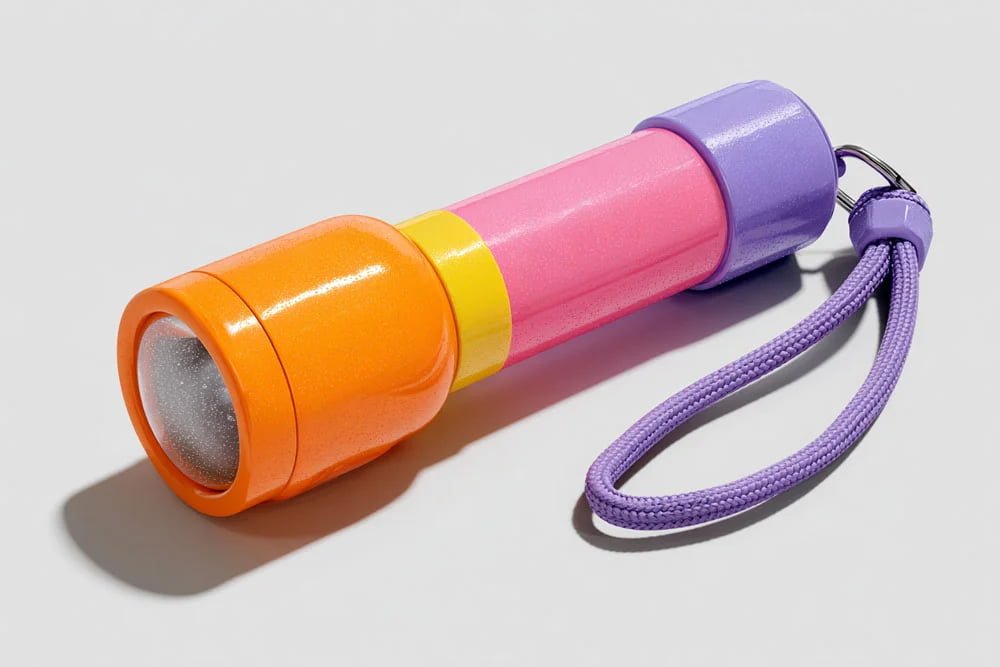
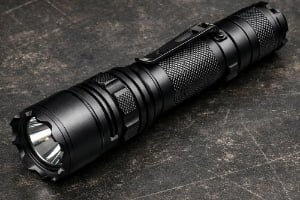
When I help clients select designs, I look for simplicity. We want to avoid parts that can break off and become choking hazards. We also need to avoid the "tactical" look. Many adult flashlights have a jagged "strike bezel" on the front for self-defense or breaking glass. This is terrible for a kid's toy. It is sharp and can hurt the child or their friends during play. The surface should be smooth. Since kids might put the light in their mouths, the plastic or coating must be certified safe.
Functionally, we do not need high-tech features like "strobe" or long-range throw. In fact, a fast strobe can trigger seizures or headaches. A slow blink is fine for visibility, but aggressive flashing is a bad idea. I strongly recommend an "auto-off" feature. Kids often fall asleep with their lights on. If the light turns off after 30 minutes of inactivity, it saves parents a fortune in batteries. Another essential feature is a lanyard or a clip. Kids lose things. A simple wrist strap14 prevents the light from being left in the woods.
Finally, a quick note on heat. High-power adult lights get hot. Since we are limiting the output to 100 lumens, heat should not be an issue. If a kid's flashlight gets hot, it is a sign of bad internal design, and you should discard it.
Conclusion
If you are building a brand, the kids' lighting market is a valuable niche with specific needs. If you are a parent, remember that safety comes first. Choose a light with low lumens, a secured battery, and safe materials to ensure your child's adventures remain fun and injury-free.
Explore this link to find top-rated flashlights that prioritize safety and usability for children. ↩
Learn why limiting brightness to 100 lumens is crucial for protecting young eyes. ↩
Discover the essential safety features of battery compartments to prevent accidents. ↩
Find out which materials are safe for children's products and why certification matters. ↩
Understand the benefits of low reading lights for children's comfort and safety. ↩
Check out KIDYWOLF's specialized products designed for children's safety and fun. ↩
Learn about HABA's commitment to creating safe and engaging products for kids. ↩
Discover LedLenser's specific lines designed for children's safety and usability. ↩
Explore VARTA's offerings that cater specifically to children's lighting requirements. ↩
Learn about Olight's flashlight options that are suitable for children. ↩
Explore Nitecore's offerings and their suitability for young users. ↩
Understand the significance of considering a child's maturity in product design. ↩
Learn about important safety certifications that ensure children's products are safe. ↩
Find out how a wrist strap can help prevent loss and enhance usability for kids. ↩