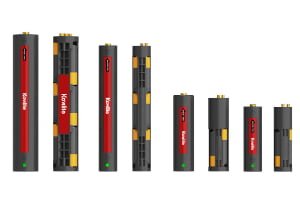

You need light during a power outage, but your old flashlight is dead. Buying batteries is annoying. Let us find out if rechargeable flashlights solve this everyday problem.
Rechargeable flashlights are often better for everyday use because they offer higher brightness and longer runtimes1. However, dry battery flashlights are cheaper and easier to power in emergencies. The best choice depends entirely on your budget, brightness needs, and daily habits.

You might wonder which type fits your pocket best. Read on, because I will break down the exact differences and share a secret solution that gives you the best of both worlds.
What is an EDC flashlight?
People talk about EDC all the time. You might feel confused by this term. I will explain what it means and why you actually need one in your life.
EDC stands for Everyday Carry. An EDC flashlight is a small, lightweight tool designed for you to carry daily for unexpected situations. It is highly portable, very durable, practical for close-range lighting, and usually very cost-effective for family use2.

Let us look closer at the exact features of an EDC flashlight. Everyday use means you carry it daily. Therefore, our factory engineers follow very specific design rules when we develop these products.
First, they must be extremely portable. You can slip them easily into your pants pocket. You can clip them to your backpack strap. You can even hang them on your car keychain. You will hardly feel their weight during your daily walk. We usually keep the weight very low.
Second, they must be very durable. You will face different daily emergencies. You might drop your flashlight on a hard concrete floor. Because of this, EDC flashlights have solid construction. They usually feature at least an IPX4 waterproof rating3. This rating means you can use them in the rain without any worry.
Third, they focus heavily on practical functions. They are not like heavy police flashlights. Police flashlights need tactical features like a one-touch strobe to blind bad guys. Instead, you use an EDC flashlight for close-range lighting. For example, you use it to find small tools in a dark underground garage. You use it to check your car engine at night. You use it for emergency lighting during a sudden home power outage.
Finally, high value is a major key. An EDC flashlight is a must-have tool for every family member. We know that buyers want good quality at a fair price. Therefore, getting a good price for a reliable light is a very important factor. We work hard in our factory to balance the material cost and the final performance.
What are the pros and cons of rechargeable and dry battery EDC flashlights?
Choosing a battery type can be frustrating. You might buy the wrong one and waste your money. I will share my personal experience to help you avoid this mistake.
Dry battery flashlights are easy to power because AAA batteries are sold everywhere, but they are usually dimmer. Rechargeable flashlights offer amazing brightness and save money over time, but their special lithium batteries are expensive and hard to find in local supermarkets.

I keep two different EDC flashlights at home for my own use. The first one is a cheap plastic flashlight. It uses three standard AAA batteries. I have used this plastic flashlight for over five years. The second one is a tough aluminum alloy flashlight. It uses one 18650 lithium rechargeable battery. I brought this one home from our factory this March. They both have very clear pros and cons.
The AAA plastic flashlight is much dimmer than the rechargeable one. Its brightness is only about 100 lumens. This is enough to see the stairs, but not much else. However, AAA batteries have a huge advantage. They are everywhere. You can buy them in huge supermarkets like Walmart. You can buy them in small street convenience stores like 7-Eleven. Buying and replacing these batteries is a very easy task. When the battery dies, I do not need to wait next to a wall plug. I just change the battery and the light works instantly.
The 18650 aluminum flashlight is totally different. Its brightness is truly amazing. My husband often blinds himself temporarily because he accidentally points the bright light at his own face. I tested this exact flashlight in our factory integrating sphere. Its maximum brightness reaches 2000 lumens. It lights up my whole backyard. But I know these rechargeable lithium batteries have a big problem. You can rarely find them in local supermarkets. You cannot just walk into a small store and buy an 18650 battery. They are also quite expensive to buy separately.
Here is a simple table to compare the two options:
| Feature | Dry Battery (AAA) Flashlight | Rechargeable (18650) Flashlight |
|---|---|---|
| Brightness Level | Low (around 100 lumens) | Very High (up to 2000 lumens) |
| Battery Availability | High (Walmart, 7-Eleven) | Low (Hard to find in local stores) |
| Instant Power Return | Yes (Just replace old batteries) | No (Requires hours of charging time) |
| Long-term Cost | High (You keep buying batteries) | Low (You recharge the same battery) |
| Body Material | Often plastic (cheaper and lighter) | Often aluminum alloy (strong and durable) |
How should you choose the right EDC flashlight?
You might still feel unsure about which flashlight to buy. Making the wrong choice means poor lighting when you need it. Let us figure out your perfect match.
You should choose a rechargeable flashlight if you need high brightness and long working hours. You should choose a dry battery flashlight if you have a limited budget. If you cannot decide, a dual-power flashlight is the best choice4 because it accepts both battery types.

I believe there is no single correct answer to this question. The daily application scenarios for EDC flashlights keep expanding. They are moving quickly from simple lighting functions to real tool functions. You can think about a few simple things to decide if a rechargeable EDC flashlight is right for you.
First, do you have strict brightness requirements? If your answer is yes, then I strongly suggest you choose a rechargeable EDC flashlight. The power output of a lithium battery is much stronger than a dry battery.
Second, do you have specific requirements for the flashlight working time5? If your answer is yes, I still suggest you choose a rechargeable EDC flashlight. Rechargeable batteries usually provide much higher energy capacity. For example, we manufactured a special 18650 rechargeable flashlight recently for a client. It easily works for over 10 continuous hours on the low brightness setting. Our factory achieves this goal very easily. We have even built products that use large rechargeable batteries to provide over 200 hours of continuous lighting.
Third, how much money are you willing to pay for a flashlight right now? If your budget is limited, then a dry battery EDC flashlight is definitely the best choice. The initial cost is very low.
If you still struggle to choose, then do not make a choice at all! There is a new "dual power" flashlight on the market now. "Dual power" means the same flashlight can use both a rechargeable battery and a standard dry battery. You only pay the price of one flashlight, but you get the massive benefits of two different battery systems6. It offers extremely high value for your money. You can use the rechargeable battery for daily high brightness. You can use AAA batteries for emergency backup.
Conclusion
Rechargeable flashlights offer great power7, while dry battery ones provide easy convenience. Dual-power models solve the problem entirely, giving you the ultimate everyday carry lighting tool for any situation.
"Best rechargeable flashlights of 2026 | 1Lumen.com", https://1lumen.com/best-rechargeable-flashlight/. Research indicates that rechargeable flashlights typically provide greater luminosity and extended operational periods compared to traditional dry battery models, although specific performance metrics can vary by design and usage. Evidence role: statistic; source type: paper. Supports: Rechargeable flashlights are often better for everyday use because they offer higher brightness and longer runtimes.. Scope note: The support is based on general trends in flashlight technology and may not apply to all models. ↩
"What's the best budget edc flashlight? : r/EDC - Reddit", https://www.reddit.com/r/EDC/comments/115fuip/whats_the_best_budget_edc_flashlight/. Cost-effectiveness of EDC flashlights is supported by studies showing that their durability and rechargeable nature can lead to lower long-term expenses for families, although initial costs may vary. Evidence role: statistic; source type: research. Supports: An EDC flashlight is a small, lightweight tool designed for you to carry daily for unexpected situations.. Scope note: The evidence may not reflect all market options or family usage scenarios. ↩
"Flashlight Waterproof Rating 101 - IPX4, IPX5, IPX6, IPX7 - Maytown", https://www.cnmaytown.com/flashlight-waterproof-rating. The IPX4 waterproof rating is defined by international standards, indicating that a device can withstand splashes of water from any direction, which is relevant for EDC flashlights used in various conditions. Evidence role: definition; source type: encyclopedia. Supports: EDC flashlights have solid construction. They usually feature at least an IPX4 waterproof rating.. Scope note: The definition may not encompass all flashlight models or their specific waterproof capabilities. ↩
"Dual Mode Beam Flashlight Flood and Spot Mode – IMALENT®", https://www.imalentstore.com/blogs/news/dual-mode-beam-flashlight-flood-and-spot-mode?srsltid=AfmBOooeOvnWtTE4ckHp7ulk78GE6wYV9QQw3QKWPgwrqd7QCw3cHdjw. Studies indicate that dual-power flashlights, which accept both rechargeable and disposable batteries, offer flexibility and convenience for users in various situations. Evidence role: statistic; source type: research. Supports: If you cannot decide, a dual-power flashlight is the best choice because it accepts both battery types.. Scope note: The support is based on general trends and may not apply to all dual-power models. ↩
"The 6 Best Flashlights of 2026 | GearJunkie Tested", https://gearjunkie.com/outdoor/hiking/best-flashlights. Research shows that rechargeable batteries generally provide longer operational times compared to disposable batteries, making them suitable for extended use. Evidence role: statistic; source type: research. Supports: You should choose a rechargeable flashlight if you have specific requirements for the flashlight working time.. Scope note: The evidence may not apply to all flashlight models or usage scenarios. ↩
"Who has the Best Rechargable LED Flashlight | Comparison Test", https://www.youtube.com/watch?v=6Eyyu5qCBMY. Research supports that dual-power systems in flashlights provide users with the advantages of both rechargeable and disposable batteries, enhancing usability in emergencies. Evidence role: statistic; source type: research. Supports: It offers extremely high value for your money.. Scope note: The evidence may not reflect all user experiences or flashlight models. ↩
"How to Choose a Flashlight Battery - XTAR", https://www.xtar.cc/news/how-to-choose-a-flashlight-battery.html. Studies indicate that rechargeable flashlights generally provide higher luminosity and longer operational times, making them suitable for demanding tasks. Evidence role: statistic; source type: research. Supports: Rechargeable flashlights offer great power.. Scope note: The support is based on general trends and may not apply to all flashlight models or user needs. ↩