
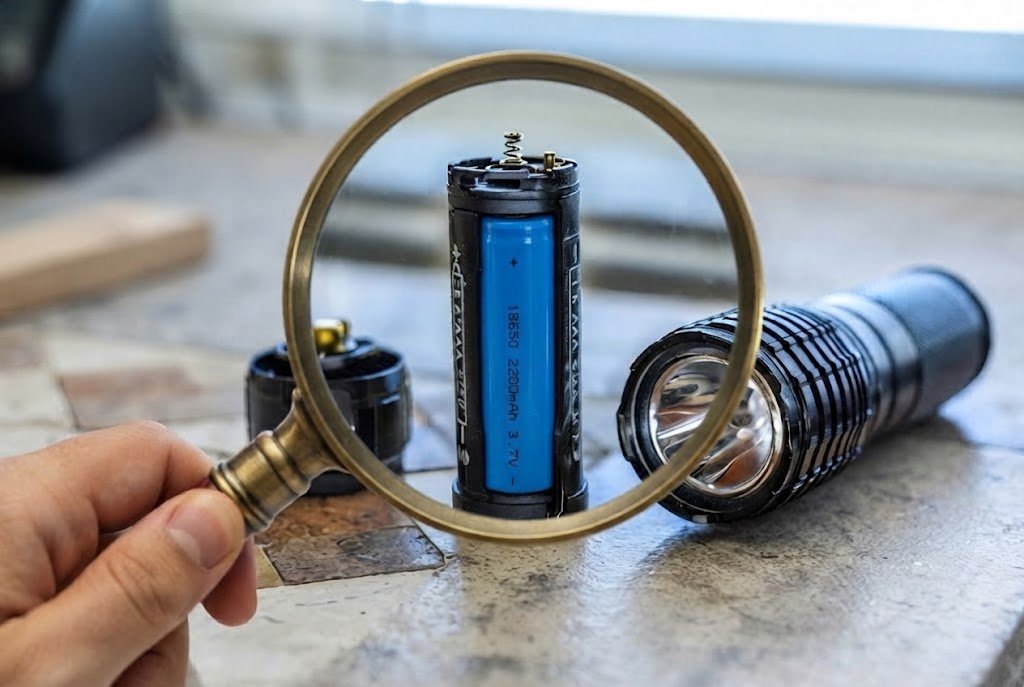
When you buy a rechargeable flashlight, you want to know how long it will work. Most people look at the mAh rating and think bigger numbers mean longer runtime.
A rechargeable flashlight battery's runtime depends on multiple factors: battery capacity, LED power consumption, driver efficiency, and heat management. One charge can last anywhere from 2 hours on high mode to 50+ hours on low mode, while the battery itself typically lasts 300-1000 charge cycles before significant capacity loss.
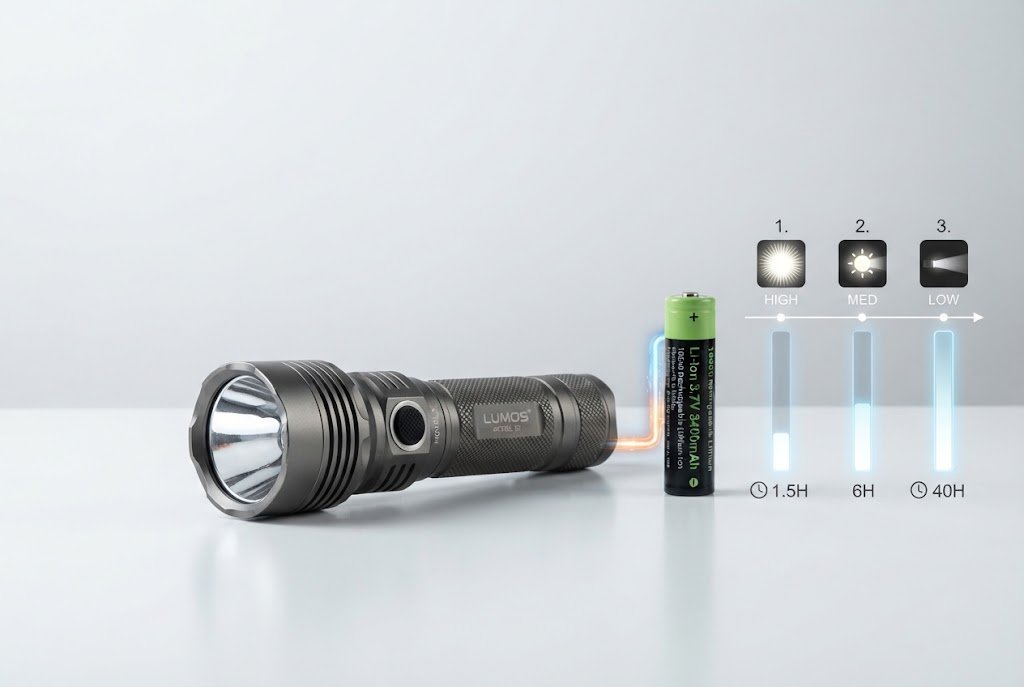
But here's what most people don't realize. Battery life actually means two different things. There's how long one charge lasts, and how long the battery stays good before it starts losing capacity. I've been developing flashlights for years, and I can tell you the answer is more complex than just looking at the mAh number.
What determines runtime per charge?
You might think a 3000mAh battery always lasts longer than a 2000mAh battery. That's not always true in real flashlights.
Runtime depends on how much power your flashlight draws, not just battery capacity. A 2000mAh battery in an efficient flashlight can outlast a 3000mAh battery in a power-hungry design. The LED brightness, driver efficiency, and thermal management all affect how long your light runs.
I learned this the hard way when developing my first high-output flashlight. I put a massive 5000mAh battery in it, expecting incredible runtime. But the LED drew so much current that it only lasted 3 hours on high. Meanwhile, a smaller flashlight with a 2000mAh battery and efficient driver ran for 6 hours at similar brightness.
The math is simple: Runtime = Battery Energy ÷ Power Consumption. But power consumption changes dramatically between modes. Your flashlight might run 50 hours on low (50 lumens), 8 hours on medium (300 lumens), 3 hours on high (800 lumens), and only 90 minutes on turbo (1500 lumens).
Here's what affects power consumption:
| Factor | Impact on Runtime | Why It Matters |
|---|---|---|
| LED Efficiency | High | Better LEDs convert more electricity to light |
| Driver Efficiency | High | Poor drivers waste energy as heat |
| Brightness Level | Very High | Power increases exponentially with brightness |
| Heat Management | Medium | Hot components become less efficient |
| Battery Voltage | Medium | Lower voltage means higher current draw |
This is why manufacturers test every mode separately. We don't just give you one "maximum runtime" number because that would be misleading.
Does higher brightness always mean shorter runtime?
More lumens definitely drain your battery faster, but the relationship isn't linear. This surprised me when I first started measuring flashlight performance.
Doubling the brightness doesn't just double the power consumption - it often triples or quadruples it. A 1000-lumen mode might use 4 times more power than a 500-lumen mode, cutting your runtime to 25% of what you'd get at the lower setting.
I remember testing a prototype that produced 2000 lumens for about 15 minutes before it got too hot and stepped down to 800 lumens. The customer complained that the "2000-lumen flashlight" didn't really give them 2000 lumens. But that's exactly how it should work.
High-performance flashlights use thermal regulation to protect themselves. When the LED gets too hot, the flashlight automatically reduces power. This isn't a defect - it's smart engineering that prevents damage and maintains reasonable runtime.
Most modern flashlights have multiple modes for this reason:
- Turbo Mode: Maximum brightness for short bursts (15-30 minutes)
- High Mode: Sustained high output (2-4 hours)
- Medium Mode: Balanced brightness and runtime (6-12 hours)
- Low Mode: Extended use (20-100 hours)
The key is sustained output - how much light can the flashlight maintain over time without overheating. A flashlight that can sustain 800 lumens for 3 hours is often more useful than one that hits 1500 lumens but drops to 400 lumens after 10 minutes.
Can you really compare mAh ratings directly?
Not always. This is one of the biggest misconceptions I see from customers comparing flashlights online.
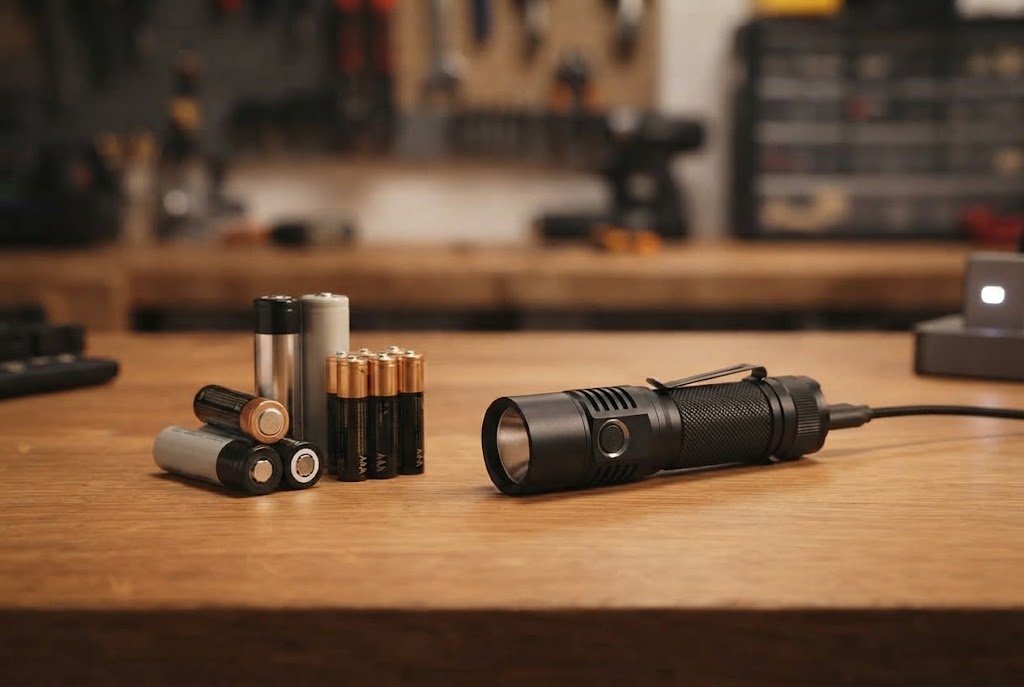
mAh measures capacity, but total energy depends on voltage too. A 2000mAh battery at 3.7V stores 7.4 watt-hours of energy, while a 2000mAh battery at 1.5V only stores 3 watt-hours. You need to look at both capacity and voltage to understand real energy storage.
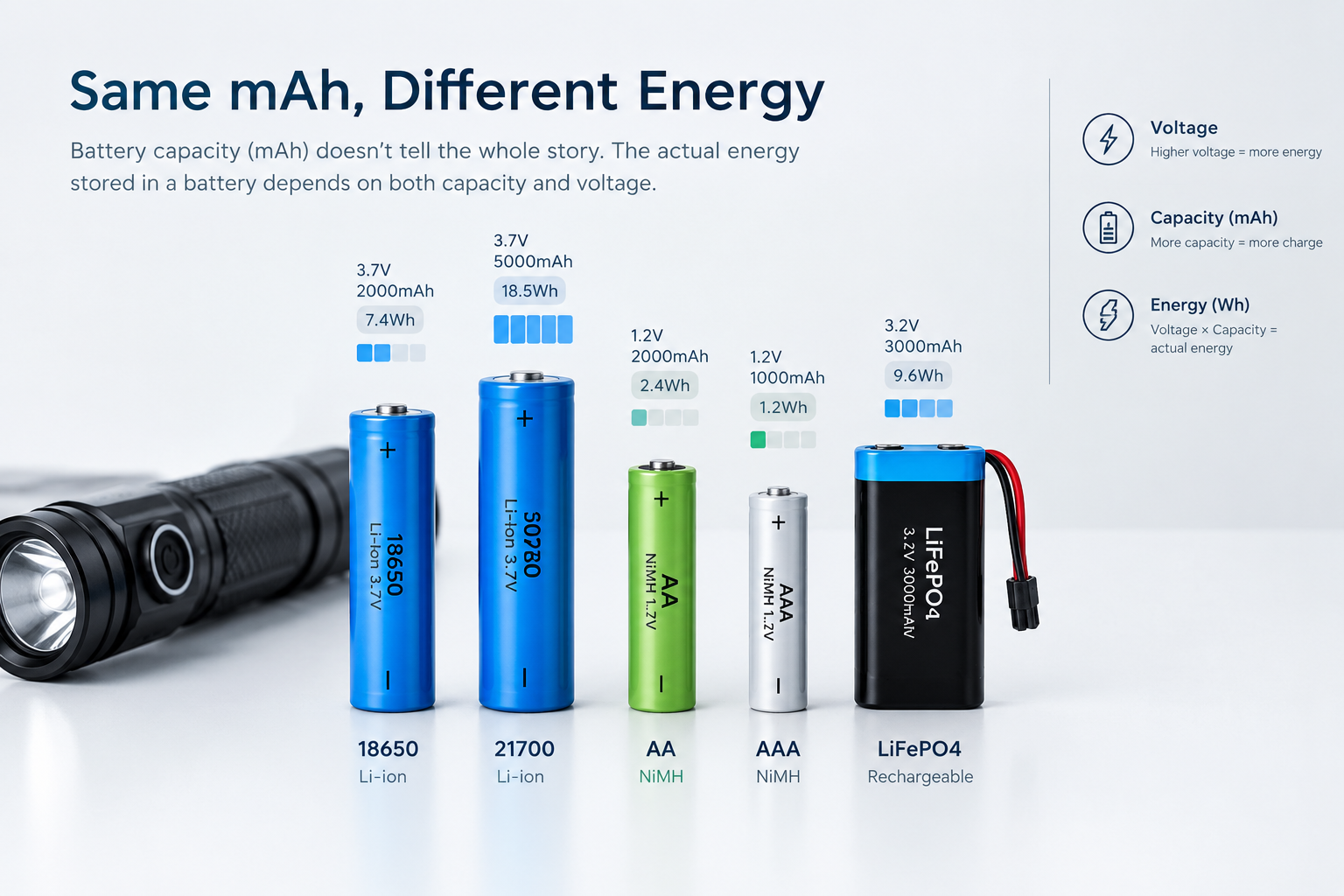
I've seen customers get confused when their new "high-capacity" AA flashlight runs shorter than their old lithium-ion model. The AA batteries might have similar mAh ratings, but lithium-ion operates at much higher voltage.
Different battery chemistries also behave differently:
Lithium-ion (18650, 21700)
- Voltage: 3.2-4.2V
- Energy density: Very high
- Discharge curve: Flat until nearly empty
- Best for: High-power flashlights
NiMH (AA, AAA)
- Voltage: 1.2V nominal
- Energy density: Medium
- Discharge curve: Gradual decline
- Best for: Budget flashlights, cold weather
LiFePO4
- Voltage: 3.2V nominal
- Energy density: Lower than li-ion
- Discharge curve: Very flat
- Best for: Long-term reliability
When I design a flashlight, I don't just pick the highest mAh battery that fits. I consider the entire system. A compact EDC light needs to balance size, weight, and runtime. A work light might prioritize durability over maximum capacity.
How many times can you recharge the battery?
Battery cycle life is another confusing specification. Most rechargeable batteries are rated for 300-1000 cycles, but what does that actually mean?
One cycle equals using 100% of the battery's capacity, but this can happen over multiple partial uses. If you use 50% today and recharge, then use 50% tomorrow and recharge, that counts as one complete cycle, not two.
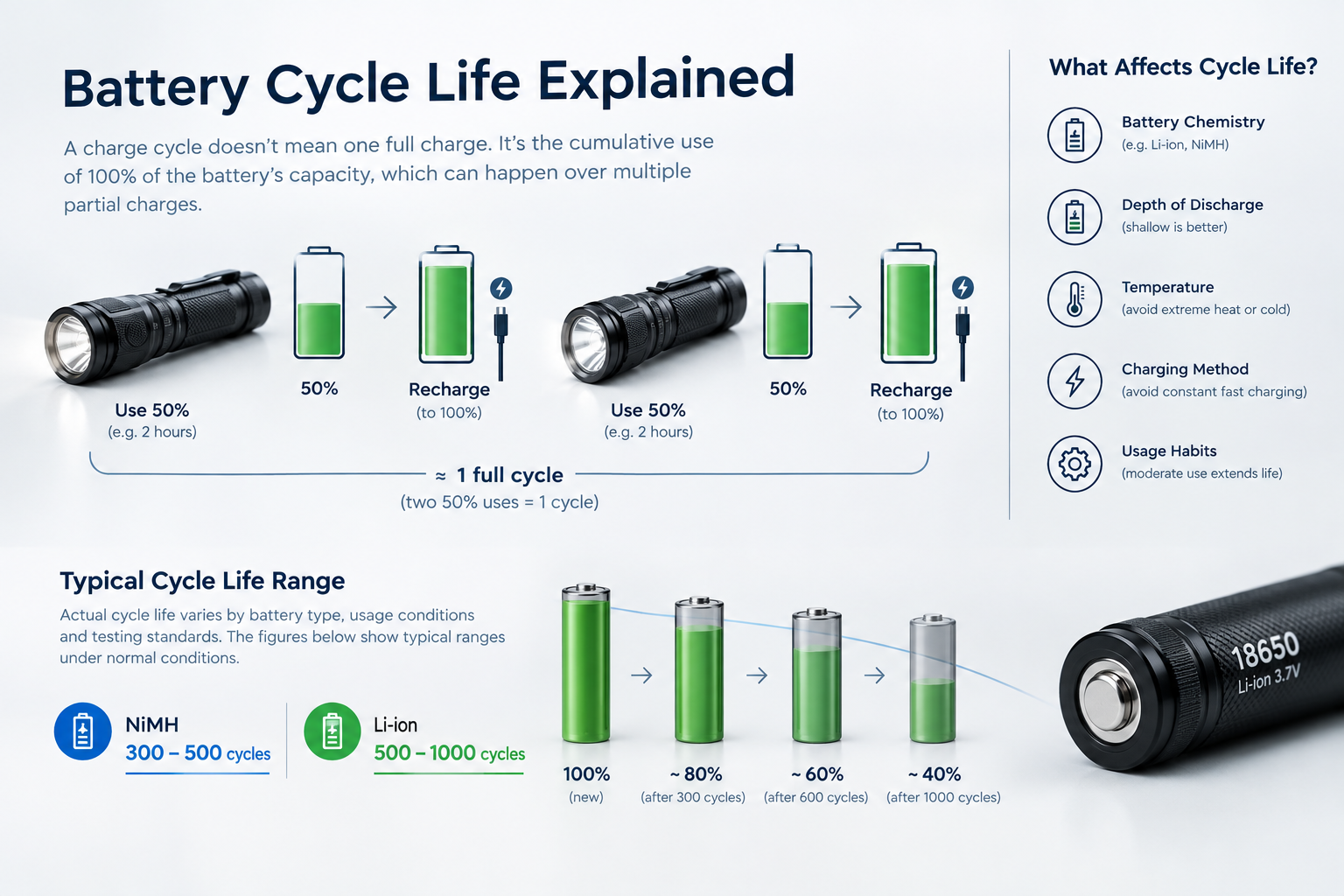
I track my own flashlight usage, and I rarely do complete discharge cycles. Most of the time, I top off the battery when it gets to 30-50%. This is actually better for battery longevity than waiting until it's completely dead.
Here's what affects cycle life:
Factors that increase battery life:
- Partial discharge cycles (20-80% usage)
- Moderate charging speeds
- Avoiding extreme temperatures
- Proper storage (40-60% charge)
Factors that decrease battery life:
- Deep discharge cycles (0-100%)
- Fast charging when hot
- Storage at 100% or 0% charge
- Extreme hot or cold conditions
In my experience, a good 18650 battery in a well-designed flashlight will maintain 80% of its original capacity after 300-500 cycles of normal use. That translates to 2-5 years for most users, depending on how often they use their light.
The cycle count also depends on how it's measured. Manufacturers test under controlled conditions that might not match your real-world usage. Temperature, discharge rate, and charging method all affect the actual lifespan you'll see.
Why does deep discharge hurt battery life?
This goes against what many people learned about older battery technologies. With modern lithium-ion batteries, you don't need to fully discharge before recharging.
Deep discharge puts extra stress on lithium-ion batteries. Regularly draining the battery to 0% can reduce its lifespan compared to keeping it between 20-80% charge. The battery management system in good flashlights prevents damage by shutting down before true zero.

I learned this lesson when I kept using an old flashlight until it completely died every time. After about a year, the runtime dropped noticeably. The battery wasn't broken, but its capacity had degraded from repeated deep discharges.
Modern flashlights have built-in protection to prevent this. When the battery voltage drops too low, the flashlight will:
- Step down to lower mode - Reduces power draw to extend runtime
- Show low battery warning - Flashing or red indicator
- Shut down completely - Prevents damage to the battery
This protection isn't just about the battery - it's about user experience too. A flashlight that suddenly dies without warning is frustrating. Good lights give you plenty of notice when the battery is getting low.
The protection circuit also prevents other damage:
- Overcurrent protection: Stops excessive power draw
- Overvoltage protection: Prevents charging problems
- Temperature monitoring: Shuts down if too hot
- Short circuit protection: Prevents dangerous failures
How does temperature affect battery performance?
Temperature is huge for flashlight batteries, especially in high-output lights that generate a lot of heat. This is something I have to consider carefully in every design.
High temperatures accelerate battery aging and can reduce immediate performance. Cold temperatures temporarily reduce battery capacity but don't cause permanent damage. Ideal operating range is 32-95°F (0-35°C) for most lithium-ion batteries.
I've tested flashlights in freezing weather and scorching heat. In cold conditions, the same battery might only deliver 70-80% of its normal runtime. But once you warm it up, performance returns to normal. Heat is worse - it causes permanent capacity loss over time.
This is why thermal management is so critical in high-power flashlights. The aluminum body isn't just for looks - it's a heat sink that pulls heat away from the LED and battery. Without proper cooling, a 2000-lumen flashlight would overheat in minutes.
Here's how different temperatures affect your flashlight:
Cold Weather (Below 32°F/0°C)
- Reduced immediate capacity (70-90%)
- Slower charging
- Performance returns when warmed
- No permanent damage
Hot Weather (Above 95°F/35°C)
- Accelerated aging
- Possible thermal shutdown
- Reduced charging efficiency
- Permanent capacity loss over time
Extreme Heat (Above 140°F/60°C)
- Risk of thermal runaway
- Possible battery damage
- Safety hazard
The best flashlights monitor temperature and adjust performance accordingly. If the light gets too hot, it will step down power automatically. This protects both the LED and the battery from damage.
Why might a high-capacity battery still have poor runtime?
I see this problem constantly in product development. A customer wants longer runtime, so they suggest using a bigger battery. But that doesn't always solve the problem.
A 5000mAh battery won't help if the flashlight has an inefficient driver, poor heat management, or excessive power draw. The entire system must work together - battery, LED, driver, and thermal design all affect runtime.
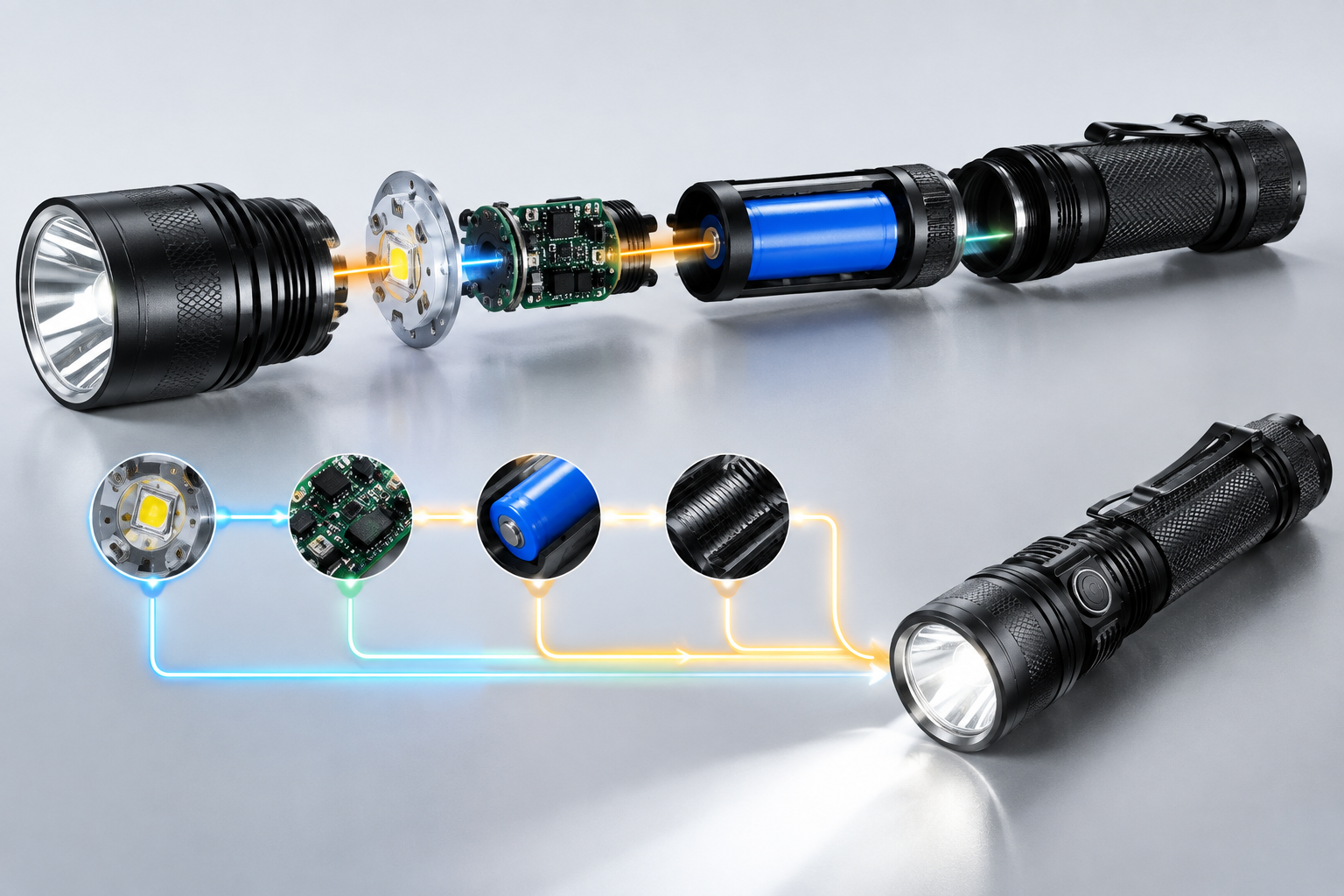
I once worked on a project where the customer insisted on a massive battery for maximum runtime. But the driver was only 75% efficient, wasting 25% of the battery's energy as heat. We could have doubled the runtime by improving the driver efficiency instead of just adding more battery capacity.
Here's what can limit runtime even with a big battery:
Inefficient Driver
- Poor voltage regulation
- High quiescent current
- Heat generation
- Solution: Better driver design
Excessive LED Power
- Too many LEDs for the application
- LEDs driven beyond optimal efficiency
- Poor thermal coupling
- Solution: Optimize LED selection and drive current
Thermal Issues
- Inadequate heat sinking
- Poor thermal interface materials
- Restricted airflow
- Solution: Improved thermal design
Parasitic Drain
- Always-on circuits
- Poor switch design
- Standby current draw
- Solution: Better power management
The most efficient approach is optimizing the entire system, not just upgrading one component. A well-designed flashlight with a 2000mAh battery often outperforms a poorly designed one with 4000mAh.
When is a battery truly “worn out”?
Battery degradation is gradual, not sudden. Most people don't realize their battery is aging until runtime drops significantly.
A battery is typically considered worn out when it holds less than 80% of its original capacity. This usually happens gradually over months or years. You'll notice shorter runtime before the battery completely fails.
I track the performance of my personal flashlights, and I've noticed the signs of battery aging:
Early Signs (80-90% capacity)
- Slightly shorter runtime
- Takes longer to charge
- Voltage drops faster under load
Moderate Aging (60-80% capacity)
- Noticeably shorter runtime
- Inconsistent performance
- May not reach full brightness
Severe Aging (Below 60% capacity)
- Very short runtime
- Possible charging problems
- Safety concerns
Replace Immediately If:
- Physical swelling or deformation
- Excessive heat during use or charging
- Leakage or corrosion
- Won't hold charge at all
The good news is that quality batteries in well-designed flashlights degrade slowly. I have 5-year-old flashlights that still perform at 85% of their original runtime. The key is proper care and not abusing the battery with extreme conditions.
Why do manufacturers focus on runtime validation?
When a customer asks for a "1000-lumen flashlight," that's just the beginning of the conversation. The real questions are about how they'll use it.
Runtime validation ensures the flashlight performs consistently throughout its intended use. We test every mode under controlled conditions to verify actual performance matches specifications. This prevents customer disappointment and warranty issues.

In my lab, we run extensive runtime tests on every new design. We measure:
- Initial brightness: Does it hit the target lumens?
- Sustained output: How long can it maintain that brightness?
- Step-down behavior: How does it reduce power when hot?
- Low voltage performance: What happens as the battery drains?
- Temperature effects: How does heat affect performance?
This testing takes days or weeks for each prototype, but it's essential. I've seen products fail in the market because the manufacturer only tested peak brightness for 30 seconds.
Real runtime testing reveals problems you can't predict from specifications:
Common Issues Found in Testing:
- Thermal step-down too aggressive
- Poor low-voltage regulation
- Inconsistent output between units
- Premature shutdown
Design Improvements from Testing:
- Better heat sinking
- Optimized driver parameters
- Improved battery protection
- More accurate specifications
The goal isn't just longer runtime - it's predictable, consistent performance that matches customer expectations.
How does complete system design affect battery life?
The best rechargeable flashlights don't just have good batteries - they have optimized systems where every component works together efficiently.
Longer runtime requires balancing battery capacity, LED efficiency, driver performance, and thermal management. The most successful designs optimize the entire system rather than maximizing any single component.
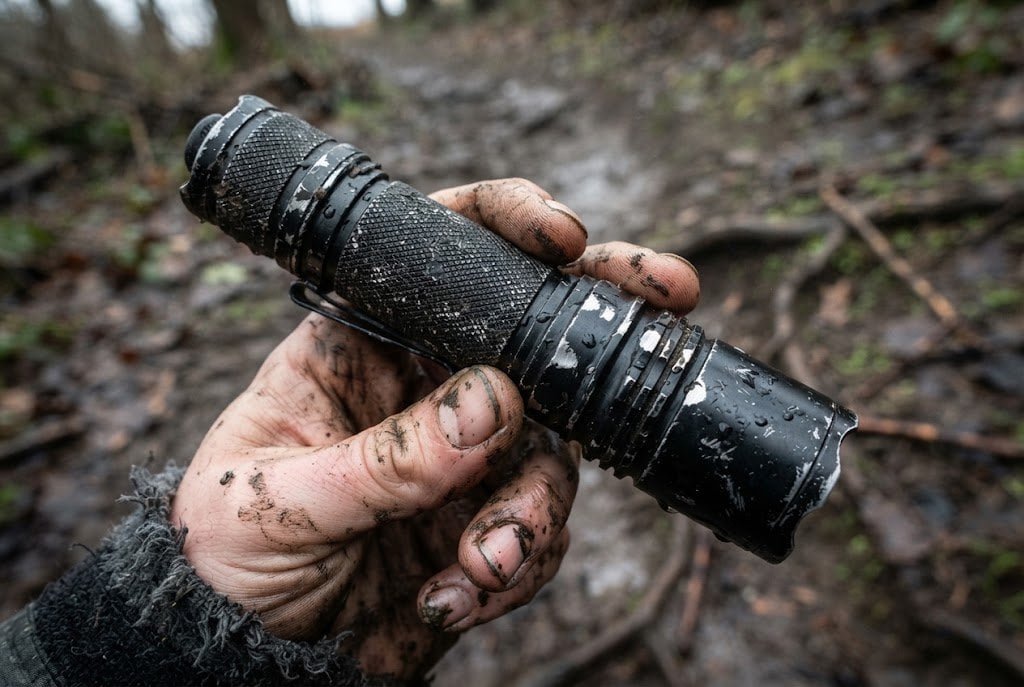
After years of product development, I've learned that the flashlight is only as good as its weakest link. You can have the best battery in the world, but if the driver is inefficient or the thermal design is poor, runtime will still disappoint.
Here's how I approach system optimization:
Battery Selection
- Match capacity to intended use
- Consider size and weight constraints
- Verify discharge characteristics
- Plan for thermal effects
Driver Design
- Maximize efficiency across all modes
- Minimize quiescent current
- Implement proper thermal protection
- Optimize for battery voltage range
LED Selection
- Choose efficient LEDs for the application
- Match drive current to efficiency peak
- Consider thermal requirements
- Plan for long-term reliability
Thermal Management
- Design adequate heat sinking
- Use proper thermal interface materials
- Consider airflow and convection
- Plan for worst-case conditions
The result is a flashlight where the battery, electronics, and mechanical design all support maximum efficiency and reliability. This integrated approach consistently produces better runtime than just upgrading individual components.
Conclusion
A rechargeable flashlight battery's life depends on the entire system design, not just capacity. Runtime per charge varies from hours to days based on brightness and efficiency, while battery lifespan typically ranges from 300-1000 cycles over several years.