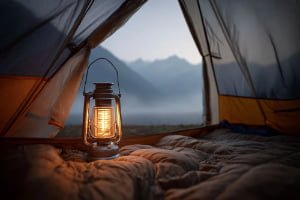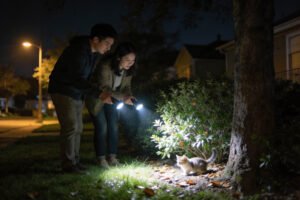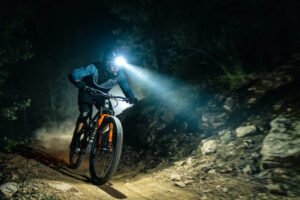

Flood beam and spotlight flashlights are two types of lighting tools used for different purposes. They differ mainly in beam angle, light intensity, and applications.
Flood beam flashlights provide a wide beam angle, typically between 60° and 120°, for large area coverage. Spotlight flashlights have a narrower beam angle1, usually between 5° and 30°, for focused, distant illumination.

The differences between these two types of beams make them suitable for various scenarios. Let’s explore what flood and spotlight beams are, their differences, applications, and even delve into extreme long-range flashlights.
What are flood light beams and spot light beams?
Flood beams and spot beams are defined by their beam angles, which is the spread of light emitted by the flashlight. Understanding beam angle is essential to knowing the differences.
Flood light beams have wider beam angles between 60° and 120°, making the light more dispersed and gentle. Spot light beams, with narrower angles of 5° to 30°, focus light into a smaller area, creating high-intensity brightness and long-range illumination.

Beam angles determine how light spreads over surfaces. Wider angles illuminate larger areas but are less intense. Narrower angles concentrate light for far-reaching illumination.
Dive Deeper: Understanding beam angle
Imagine switching a flashlight beam from wide to narrow. The wider flood beam is ideal for lighting up nearby areas, while the narrow spotlight beam is perfect for pinpointing faraway objects. Beam angle is often specified in degrees, making it easier to categorize flashlights for specific tasks.
Flood beams are perfect for gentle, wide-area lighting2. They work well for tasks requiring close, broad coverage. Spot beams excel in long-range focus, allowing users to concentrate light on distant targets.
What are the differences between flood beam and spotlight flashlights?
Flood beams and spot beams differ in beam angle, lighting effects, and application. Here’s how they compare:
| Attribute | Flood Beam | Spot Beam |
|---|---|---|
| Beam Angle | 60° to 120° | 5° to 30° |
| Lighting Effect | Covers large areas, dispersed | Focused, intense, far-reaching |
| Applications | Camping, work, reading, etc. | Search, rescue, hunting, etc. |
Flood beams offer softer lighting for nearby spaces. Spot beams create concentrated brightness for distant objects. These characteristics make them ideal for different use cases.

Dive Deeper: Practical examples
Flood beams are suitable for activities like reading or working in dark areas. Their wide coverage makes them less harsh and better for close-proximity tasks. Spot beams are used in search and rescue operations, where pinpointing a distant object is critical.
Choosing between flood and spot beams depends on the activity. Wide-area tasks benefit from flood beams, while long-range precision tasks favor spot beams.
What applications and choices suit flood and spot beams?
Flood and spot beams have distinct applications. Here’s how to choose based on specific scenarios:
| Activity | Recommended Beam | Reason |
|---|---|---|
| Night hiking | Combination | Flood for close paths, spot for distance |
| Everyday carry (EDC) | Flood + weak spotlight | Wide coverage for close tasks |
| Mechanical repairs | Flood with slight spot | Broad area lighting + focused details |
| Night fishing | Flood beam | Large water surface coverage |
| Hunting/search tasks | Spot beam | Focused illumination for distant targets |
| Emergency home lighting | Flood beam | Wide coverage for interior spaces |

Dive Deeper: Examples of use
For hiking, a combination of flood and spot beams provides optimal lighting. Flood beams illuminate nearby trails, while spot beams show distant terrain. For EDC, a flashlight with a flood beam and weak spotlight is perfect for small household tasks.
Choosing the right beam depends on the activity3. Always consider the surroundings and distance requirements when selecting a flashlight.
What are extreme long-range flashlights (Throwers)?
Extreme long-range flashlights, known as “Throwers,” represent a specialized category of spot beams. They are engineered for maximum beam focus and distance.
Throwers typically have beam angles between 5° and 8°. They use advanced technologies for concentrated, long-range illumination. These technologies include:
- LEP (Laser Excited Phosphor): Uses a laser diode to emit light. The beam is ultra-focused and reaches impressive distances. The phosphor converts blue light into white light for output.
- High-power LED: Utilizes powerful LEDs with large reflectors or lenses to compress the light beam for extreme reach.

Dive Deeper: Comparing LEP and LED throwers
| Feature | LEP Throwers | LED Throwers |
|---|---|---|
| Technology | Laser excitation | High-power LED |
| Beam Focus | Ultra-concentrated | Focused but broader |
| Applications | Precision targeting | Extended area scanning |
LEP throwers are used for tasks requiring exceptional precision4, like spotting a distant object in pitch darkness. LED throwers balance reach and intensity5, making them suitable for broader scenarios.
Extreme long-range flashlights are a niche product. They are invaluable for specialized tasks but might not be necessary for everyday use.
Conclusion
Flood beams diffuse light for wide coverage, while spot beams focus light for distant precision. Applications range from everyday tasks to extreme long-range needs. Choosing the right flashlight depends on the activity and environment.
"SPOTLIGHT Definition & Meaning - Merriam-Webster", https://www.merriam-webster.com/dictionary/spotlight. Spotlight flashlights are defined by their narrower beam angle, usually between 5° and 30°, which allows for focused illumination. Evidence role: definition; source type: encyclopedia. Supports: Spotlight flashlights have a narrower beam angle.. Scope note: The definition is based on general characteristics and may vary by specific flashlight models. ↩
"Dual Mode Beam Flashlight Flood and Spot Mode – IMALENT®", https://www.imalentstore.com/blogs/news/dual-mode-beam-flashlight-flood-and-spot-mode?srsltid=AfmBOop4ECS1JP8o80WITdbN1XZwi9_7YgJYbRH56-bGzt1j_iKhPwxp. Flood beams are designed to provide softer lighting for nearby spaces, making them suitable for tasks requiring close, broad coverage. Evidence role: general_support; source type: research. Supports: Flood beams are perfect for gentle, wide-area lighting.. Scope note: The support is based on general usage and may not apply to all flood beam flashlights. ↩
"How to Choose Flashlights", https://www.rei.com/learn/expert-advice/flashlight.html. The choice of flashlight beam is influenced by the specific activity and environment, highlighting the importance of selecting the appropriate type for the task. Evidence role: expert_consensus; source type: education. Supports: Choosing the right beam depends on the activity.. Scope note: The support is based on general consensus and may not apply to all situations. ↩
"What do people use an LEP for? : r/flashlight - Reddit", https://www.reddit.com/r/flashlight/comments/12k38q4/what_do_people_use_an_lep_for/. LEP throwers are specifically designed for precision targeting, making them suitable for tasks that require exceptional focus and distance. Evidence role: case_reference; source type: research. Supports: LEP throwers are used for tasks requiring exceptional precision.. Scope note: The support is based on general usage and may not apply to all LEP throwers. ↩
"Enormous lighting power with Flooder & Thrower flashlights - Ledlenser", https://ledlenser.com/en/advisor/flooder-thrower-flashlights/. LED throwers are designed to provide a balance between reach and intensity, making them suitable for a variety of scenarios. Evidence role: general_support; source type: research. Supports: LED throwers balance reach and intensity.. Scope note: The support is based on general usage and may not apply to all LED throwers. ↩